
Wem gehört der Weltraum?
Texte
Who owns space?
From humanity’s dream to a geopolitical battleground between raw materials, the military and power
For a long time, space was the great object of humanity’s longing: a place for science, discovery and the hope that, beyond the conflicts on Earth, there might yet be something greater. Yet this romantic notion is increasingly at odds with the present reality. Today, orbit is not merely being mapped, but strategically analysed. The Moon is no longer just a symbol, but a target once more. Asteroids are no longer merely celestial bodies, but potential sources of raw materials. And space has long since ceased to be merely a stage for research, but is increasingly also a theatre of power politics, security interests and economic dominance.
The legal framework appears clear at first glance: Under the United Nations Outer Space Treaty, outer space – including the Moon and other celestial bodies – is not subject to national appropriation by claim of sovereignty, use or occupation. At the same time, the same treaty framework stipulates that outer space may be freely explored and utilised by all states. In other words: no state may ‘own’ the Moon in the same way as it owns a territory on Earth. Yet many states and companies have long been working on rules designed to effectively secure their use, access and commercial exploitation of space. It is precisely in this grey area that the real battle for space begins.
This grey area is becoming increasingly apparent. The Artemis Accords, launched in 2020 by NASA and partner states, are intended to establish fundamental principles for safe and peaceful civil space exploration. On 20 April 2026, Latvia became the 62nd signatory state. The Accords emphasise transparency, registration, data sharing, emergency assistance, the protection of space heritage, the management of orbital debris and, explicitly, the use of space resources. At the same time, they provide for so-called ‘safety zones’: areas in which activities are to be coordinated in order to avoid ‘harmful interference’. Formally, these zones are intended solely to organise safety and mutual consideration. Politically, however, they also serve as a foretaste of future spheres of influence in areas where raw materials, infrastructure and strategic positions will later become particularly valuable. The issue of raw materials is therefore particularly revealing.
NASA describes the ability to extract and utilise resources on the Moon, Mars and asteroids as ‘critical’ for safe and sustainable space travel. Luxembourg goes one step further: according to the Luxembourg government, it was the first country in Europe and the second worldwide to create, through its 2017 law, a legal framework recognising that space resources can be appropriated. This is the real turning point. For even though no one may claim the Moon as state property, the debate has long since shifted towards the question: Who owns the materials extracted there? Whoever mines first creates a fait accompli. Whoever sets the rules for their use may not own the celestial body itself — but they certainly hold the economic leverage.
This is also changing the moral narrative of space exploration. The old dream of ‘humanity in space’ is gradually giving way to a race for standards, infrastructure and access. Legally, space may belong to no one. In practice, however, states, agencies and companies are already attempting to shape the conditions of its use: through treaties, legal frameworks, missions, landing technology, communications networks and future supply routes. In space exploration, ownership does not begin with the planting of a flag.
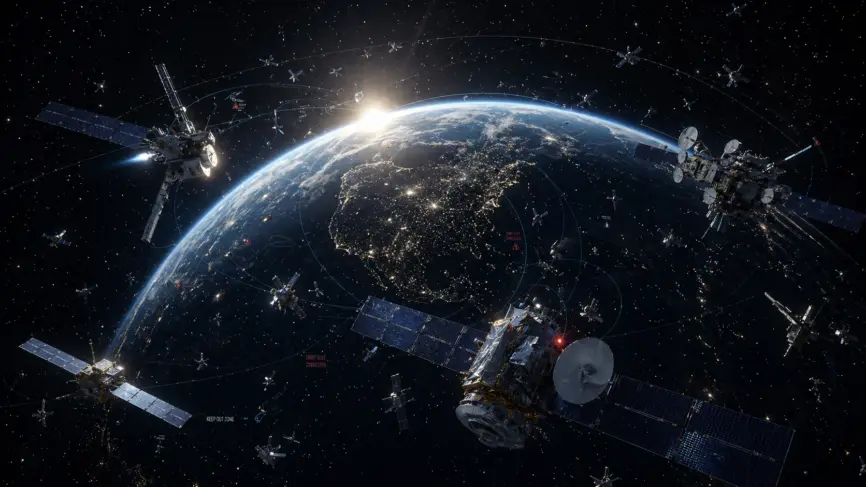
Ownership begins with the establishment of rules, a physical presence and logistical control. Added to this is a second, darker development: militarisation. Whilst the Outer Space Treaty prohibits the deployment of nuclear weapons and other weapons of mass destruction in orbit, this by no means implies that space has remained politically neutral. The CSIS describes, for 2025, a continued development of anti-space capabilities, increasing GPS jamming and spoofing in conflict zones, as well as growing manoeuvring capabilities of Chinese and Russian satellites, which may be relevant to warfare in space. Space has thus long since become a military multiplier: whoever controls communication, navigation, reconnaissance and timing controls not only satellites today — but entire wars.
This is precisely why the question ‘Who owns space?’ is so misleading. The legally sound answer is: no single nation owns it. The more realistic answer is: it is already being divided up – not in the form of traditional maps, but through technology, treaties, security architecture and economic dominance. Those who possess launch capabilities, set standards, can extract resources, define security zones and establish a permanent presence are creating a new kind of power in the 21st century. No longer colonialism by gunboat, but colonialism through countries, data and operating rights.
And that is precisely why space is no longer a distant science-fiction topic today. It is a mirror of Earth. Everything that has shaped humanity down here — competition, hope, expansion, fear, inventiveness, the will to power and the hunt for scarce resources — rises with it into space. The crucial question for the future, then, is not merely whether we will return to the Moon or Mars. It is which civilisation will arrive there: one that regards space as a shared heritage — or one that turns it into the next zone of plunder.